

A Mother’s Day reflection for women walking through abuse
Mother’s Day can feel complicated in ways others don’t always see.
For some moms, it brings questions that are hard to say out loud.
You love your children deeply. You would do anything for them.
And yet, you may be wondering, am I a bad mom for staying?
It’s a question many mothers carry quietly.
Recently, we reached out to our Hagar’s Sisters community of survivors and asked what they would say to a mom living this reality day-to-day.
Two women from our community responded. Jenny, a mother and survivor who has spent years walking alongside women in support groups, and one of our Care Coordinators, Milagros, who also shared from her own lived experience as a mother who has been there.
As we listened, it became clear that this one question is rarely the only one.
So many others come with it.
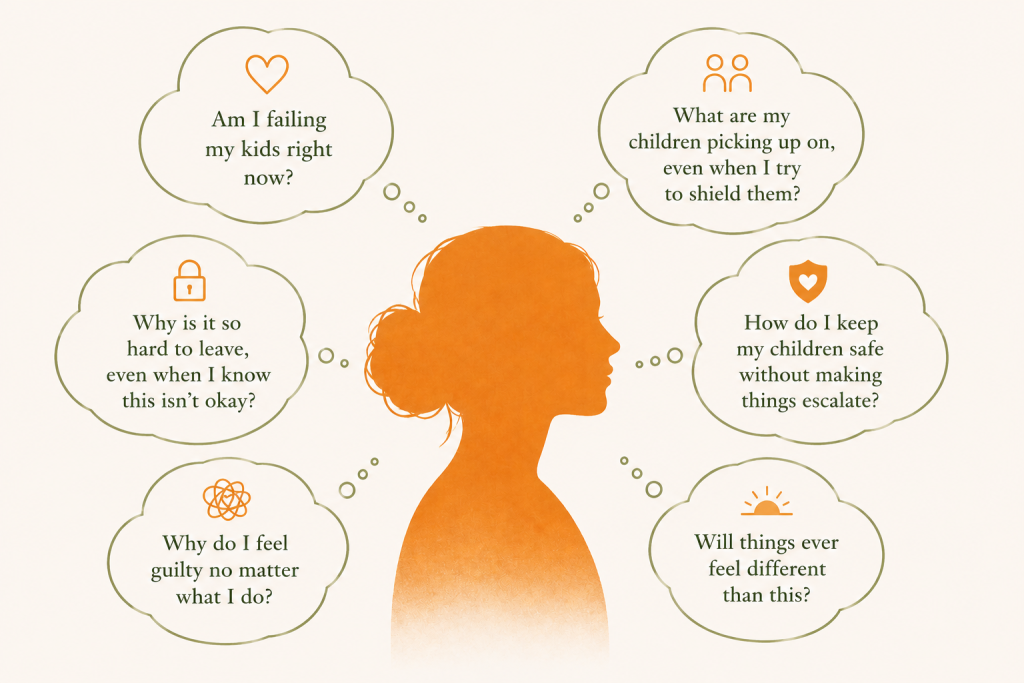
If you’ve found yourself asking any of these, you are not alone.
What follows is a reflection built from both of their voices.
We hope that somewhere in these words, you find a bit of steadiness for where you are right now.
Am I a Bad Mom for Staying in an Abusive Relationship?
Jenny offered this perspective.
“I believe every Mom should release the “Bad Mom” stigma by replacing it with these thoughts instead – “I did/am doing the best for my children with the information I have at the time”. The decision to leave or stay is very complicated. While witnessing abuse has been shown to do psychological harm to children, there are hurdles to overcome with children in and after divorce. There is no right or best answer, only the right or best answer for you. Including professionals such as child counselors and teachers may help you to get an overall picture of how your child is doing in the current environment.”
Milagros shared, “for a long time, I felt like I was a bad mom for staying,”
She knew what was happening in her home was not right. She knew her children were likely seeing and feeling more than they should. And still, she stayed.
Not because she did not care.
But because she did.
She wanted to keep her family together. She believed her children deserved a home with both parents. She was trying to create peace in a place that often felt unpredictable.
The bottom line is, you are not a bad mom.
You are a mom trying to protect, to provide, and to hold things together in a situation you never chose. You are navigating something complex while trying to care for your children in the best way you know how, with the information and resources you have right now. That does not make you a bad mom. It reflects just how much you care.
What Are My Children Picking Up on in an Abusive Home?
“They know everything,” Milagros said.
“Children notice more than we wish they did. They pick up on tension, tone, and the emotional environment of a home, even when they are not directly in the room. That’s why at the end of the day, I always made sure to show them love and care. Those things matter.”
Jenny shared that “Your children observe and feel more than you know. While shielding them as much as possible is a good and important goal, children pick up on tension, environmental clues, and your mood, probably more than you realize. A counselor for your child is a good idea, mainly because a counselor can give you a professional assessment of how things are affecting your child.”
There is something else to hold onto here.
Your children also see YOU.
They see your care. Your presence. The ways you comfort them and try to create peace.
Those moments matter.
When you hold all of this together, there is something important to remember. While your children may notice the tension and the difficult moments, that is not the whole story of what they are experiencing. They are also experiencing your love, your consistency, and your presence. The way you show up for them, even in small, steady ways, is shaping them more than you may realize.
Why Is It So Hard to Leave an Abusive Relationship?
“Because life is not simple.”
Jenny outlined just how many factors come into play, “Finances, child care, jobs, a place to live, lawyers, restraining orders, loss of friendships, extended family pressure, custody arrangements, safety, division of property…the list seems endless. In addition to all these things, if you still love your partner, it is hard to conceive of a final break. Just be reminded that the Cycle of Abuse generally does not stop without a monumental change, and overwhelmingly, that change that will come from the person being abused.”
Milagros shared that when she left, it was in a moment where she felt she had to. But before that, there was time spent thinking, preparing, and trying to understand what leaving would actually require.
If you are in that place, it does not mean you are weak.
It means you are navigating something incredibly complex. We understand. There may be no clear answer at the moment. It’s a journey. One we’re here to walk with you. If you’re considering learning or exploring more, please reach out on our BeginYour Journey page.
How Do I Keep My Children Safe During Abuse?
This is one of the hardest questions to carry.
Milagros spoke about her own strategies, “I remember making sure the house was clean and everything was done before he got home, just hoping that maybe it would prevent an outburst. I was always thinking, ‘What can I do to keep things calm today?’
If I felt like something might happen, I would adjust the evening. Sometimes I’d put the kids to bed early. Sometimes I’d try to keep them busy or out of the way so they wouldn’t have to see anything.
There were times I would have people over on purpose, because I knew he wouldn’t act the same in front of others.”
Jenny emphasized the importance of having a plan where possible. Knowing where important documents are, having essentials ready, and identifying people who can step in if needed.
Furthermore, “Women’s Crisis Centers often have invaluable resources that address these very things. In addition to having child counselors available, they can provide cell phones that will dial “911” that you can have your children carry.”
Support can make a difference here.
You do not have to figure that out alone.
Why Do I Feel Guilty All the Time as a Mom?
Because you care deeply.
Milagros shared that in the middle of everything, she was focused on getting through each day. The guilt came later, once there was space to process everything that had happened.
Jenny offered a simple but powerful reframing, “you are doing the best you can with what you know and what you have right now.
That does not erase the weight of it. But it can begin to soften it.
Will Life Ever Feel Peaceful Again After Abuse?
“Yes, it does get better,” Milagros said.
Not instantly. Not all at once.
But over time, she described a shift. The anxiety began to ease. The fear became quieter. A sense of peace slowly returned.
Jenny echoed that healing is a process, “When the Cycle of Abuse is broken, you will begin a journey of healing. This journey is a long walk into being a person that will become sure of herself, joyful, strong, independent, and loved by the God who Sees. All journeys take time, but the relief you will feel when you are no longer a captive on that wheel is immense.”
There is more ahead than what you are experiencing right now.
Encouragement for Moms Experiencing Domestic Abuse
Be kind to yourself.
You are carrying more than most people can see.
Find someone who will listen. Even one safe person can make a difference.
Take small moments for yourself when you can. A walk. A quiet moment. Something that reminds you that you are still there too.
And most of all
Hold on.
It gets better.
Maybe slowly. Maybe in ways you do not expect. But it does get better.
If you are reading this and seeing pieces of your own story, you do not have to walk through it alone.
At Hagar’s Sisters, we are here to listen, to support, and to walk alongside you at your pace.
You are not alone in this. 💜